This guide is for general information and education only and is not financial, tax, or legal advice — consult a qualified professional before acting on these figures.
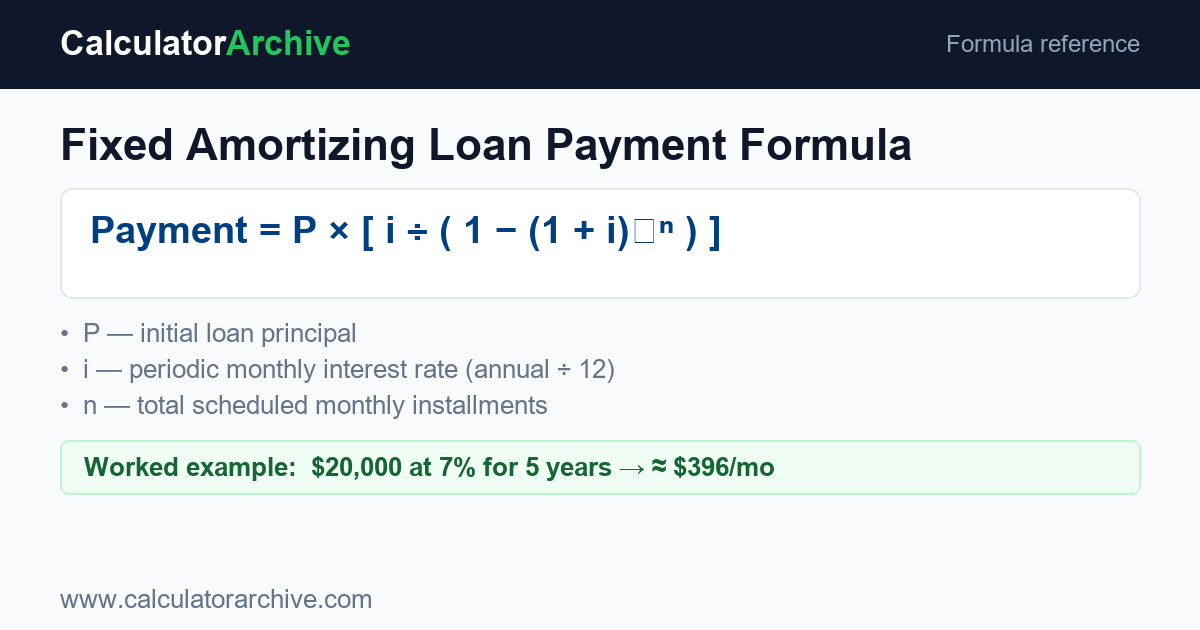
The amortizing loan payment formula at a glance.
Comprehensive Guide to Personal Loans, Amortization Schedules & Borrowing Costs
A personal loan gives you a lump sum that you repay in fixed monthly installments. This guide covers rates, fees, and how to compare offers in plain terms.
Whether you are seeking to consolidate high-interest credit card balances, finance home remodeling, fund medical procedures, or cover emergency expenses, our Loan Calculator is engineered to provide complete financial clarity. By inputting your borrowing principal, contractual interest rate, and loan repayment term, you can instantly evaluate your scheduled monthly payment, total interest charges, and the precise month-by-month trajectory of your debt payoff.
Standard Fixed Amortizing Loan Payment Formula:
Payment = P × [ i / (1 - (1 + i)⁻ⁿ) ]
Where: P = Initial loan principal; i = Periodic monthly interest rate (annual nominal interest rate divided by 12); n = Total number of scheduled monthly installments (loan duration in years multiplied by 12).
Nominal Interest Rate vs. Annual Percentage Rate (APR)
A frequent pitfall for borrowers is conflating the nominal interest rate with the Annual Percentage Rate (APR):
Nominal Interest Rate: The baseline percentage rate charged on the borrowed principal, excluding any supplementary lender fees.
Annual Percentage Rate (APR): The true, all-inclusive economic cost of borrowing over a one-year period. The APR incorporates origination fees, administrative processing charges, underwriting expenses, and required insurance premiums. Comparing loan offers solely on nominal rates is misleading; APR is the standardized benchmark mandated by consumer finance protection regulations worldwide.
How does the Debt-to-Income (DTI) ratio affect loan approval?
The Debt-to-Income (DTI) ratio quantifies the percentage of your gross monthly income devoted to satisfying recurring debt obligations (housing, auto loans, student loans, and credit card minimum payments). Financial underwriting institutions generally prefer a front-end DTI under 28% and a back-end DTI under 36% to 43%. A lower DTI signifies healthy disposable income buffers, yielding favorable underwriting tiers and lower offered interest rates.
What is the difference between Simple Interest and Rule of 78 loans?
In modern simple interest loans, interest accrues daily or monthly solely against the remaining unpaid principal balance, meaning early payoffs dramatically reduce total interest costs. Conversely, precomputed loans utilizing the outdated Rule of 78 or "flat rate" calculations heavily front-load interest into the earliest payments, significantly diminishing the financial advantage of early debt cancellation.
United States: Governed by the Truth in Lending Act (Regulation Z) and supervised by the Consumer Financial Protection Bureau (CFPB), requiring standardized Loan Estimates and Closing Disclosures. Creditworthiness is evaluated via FICO or VantageScore credit algorithms (ranging from 300 to 850), where scores above 720 unlock prime interest tiers.
European Union & UK: Governed by the Consumer Credit Directive and FCA statutory rules. Lenders must supply the Standard European Consumer Credit Information (SECCI) document prior to agreement signing, and borrowers possess an unconditional 14-calendar-day statutory right of withdrawal.
India: Supervised by the Reserve Bank of India (RBI) under the Fair Practices Code and Digital Lending guidelines. Lenders must state the Key Fact Statement (KFS) upfront, with creditworthiness heavily benchmarked against CIBIL scores (where 750+ represents the prime standard).
Middle East & GCC: Consumer loans are regulated by monetary authorities like SAMA (Saudi Arabia) and CBUAE (UAE). Typical guidelines cap consumer credit tenors at 60 months (5 years) and limit aggregate debt obligations to 33.33% of monthly salary (or up to 50% including housing finance). Sharia-compliant facilities structure personal financing via Tawarruq or Commodity Murabaha rather than interest-bearing notes.
Loan Term (Years)
Monthly Payment Pressure
Total Cumulative Interest Paid
Recommended Financial Strategy
1 to 2 Years (Short Term)
High monthly cash requirement
Minimal total interest expense
Ideal for rapid debt consolidation or minor home repairs with stable income
3 to 4 Years (Medium Term)
Balanced, predictable payments
Moderate interest accumulation
The standard benchmark for major personal projects balancing monthly budget and cost
5 to 7 Years (Long Term)
Lowest monthly payment burden
High overall borrowing expense
Useful for large expenditures, but carries higher cumulative interest burden